

A utility crew arrives at a planned excavation with a map showing a water main somewhere beneath the roadway. The pipe is believed to be PVC. The valves are difficult to identify, the original construction records are incomplete, and no usable signal can be detected from the tracer wire.
The excavation still needs to proceed, but the utility cannot confidently mark the pipe.
This is a common challenge for water utilities managing older PVC, HDPE, asbestos cement, concrete, and other non-metallic infrastructure. Conventional electromagnetic locating equipment works well when it can induce a signal onto a conductive pipe or tracer wire. When neither is available, utilities must use a different combination of records, field investigation, geophysical equipment, acoustic locating, and physical verification.
Understanding the available options can help crews locate water mains without tracer wire while reducing unnecessary excavation and the risk of damaging critical infrastructure.
Why Water Mains Need Tracer Wire
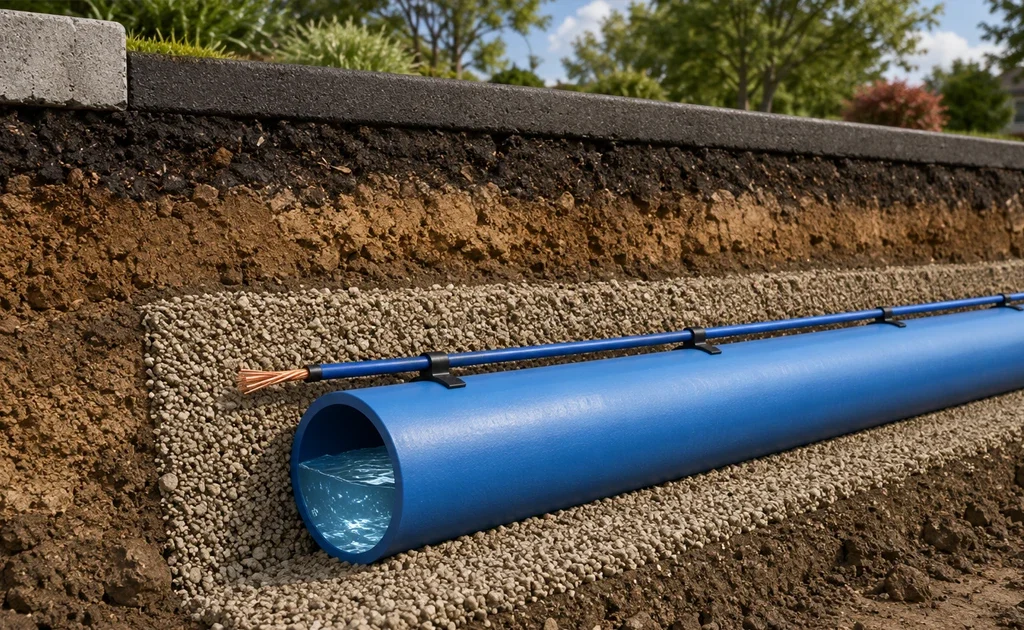
Most conventional pipe locators detect an electromagnetic signal carried by a conductive material. Metallic water mains can often carry that signal directly. Plastic pipe cannot.
Tracer wire addresses this problem by providing a conductive path alongside a non-metallic pipe. A locator connects a transmitter to an accessible end of the wire, applies a signal, and follows that signal from the surface.
Government guidance for plastic gas infrastructure describes the same basic principle: conventional pipe locators detect metal rather than plastic, so tracer wire or metallic locating tape is installed with the pipe to make it locatable.
When properly installed, connected, grounded, tested, and documented, tracer wire remains one of the most effective ways to locate new plastic water infrastructure.
The problem is that underground infrastructure may remain in service for many decades. The tracer wire system does not always remain usable for the same length of time.
Why Tracer Wire Fails
A tracer wire system is only useful when the locator can access it and the wire provides a sufficiently continuous conductive path. A failure at one splice, termination, access point, or damaged section can make a long portion of water main difficult to trace.
A 2024 report prepared for the U.S. Congress specifically identified corrosion and breakage over time as challenges that can make tracer wire unreliable, particularly on older plastic pipelines.
Several conditions commonly contribute to tracer wire failure.
Older Installations
Many older plastic water mains were installed before tracer wire requirements became consistent. Some have no wire at all. Others may have short sections of wire, inaccessible termination points, or systems installed under earlier standards.
Even where tracer wire was included, utilities may not know:
- Where the access points are located
- Whether the wire was tested after installation
- How splices and branches were connected
- Whether repairs maintained continuity
- Whether the wire follows the actual pipe alignment
An older drawing might indicate that tracer wire was specified, but that does not guarantee that the system remains accessible or functional today.
Construction and Installation Mistakes
Tracer wire can be damaged while the pipe is being installed, backfilled, connected, or commissioned. It may also be installed too far from the pipe or terminated without an accessible connection point.
Potential installation problems include:
- Wire cut during installation
- Improper or unsealed splices
- Loose connections
- Wire pulled apart during backfilling
- Incompatible connectors
- Missing grounding components
- Wire omitted across fittings, valves, or repaired sections
- Access leads buried beneath asphalt, soil, or concrete
- Failure to test electrical continuity before acceptance
Modern water and sewer tracer wire specifications frequently require direct-burial, corrosion-resistant connectors, accessible test stations, immediate repair of installation damage, and post-installation continuity testing. These requirements reflect the types of problems that can compromise a tracer wire system.
Corrosion and Moisture Intrusion
Tracer wire operates in a wet, chemically active underground environment. Damage to the wire jacket or poorly sealed connections can allow moisture to reach the conductor.
Over time, corrosion can increase electrical resistance or completely interrupt continuity. Connections, splices, and exposed termination points are especially vulnerable when they are not properly sealed or protected.
This is why current specifications commonly call for corrosion-resistant connectors, direct-burial-rated components, protective coatings, and suitable grounding systems.
A PVC tracer wire may appear intact at an access point but still be broken or severely degraded farther along the alignment.
Construction and Repair Activity
A tracer wire can work for years and then become unusable after unrelated construction.
Road reconstruction, landscaping, service repairs, valve replacements, hydrant work, utility crossings, and emergency excavations can all damage the wire. A repair crew may reconnect the water main without restoring the tracer wire system.
As a result, one portion of a main may locate normally while the signal disappears beyond a repaired section.
Missing or Inaccurate Records
Records do not cause tracer wire failure, but poor documentation makes a failed wire much harder to overcome.
Legacy utility maps may show an approximate alignment rather than a surveyed position. Some records were created from design drawings and were never updated to reflect field changes.
Common uncertainties include:
- The main was installed on a different alignment than designed
- Bends and offsets were not documented
- A replacement section follows a new route
- A service was abandoned but remains in the ground
- Valve or hydrant records were not updated
- Coordinates were transferred from older local reference systems
- Maps show connectivity but not precise horizontal position
Utilities attempting to locate abandoned water mains face an additional problem. The pipe may no longer connect to an active system, and visible appurtenances may have been removed or buried.
How to Locate a Water Main Without Tracer Wire
There is no universal buried water main locator that works in every soil, pipe material, depth, and site condition.
Utilities usually achieve the best results by combining multiple sources of evidence rather than relying on a single tool.
1. Review Records and Reconstruct the Likely Alignment
The first step is to gather every available record, including:
- As-built drawings
- Valve and hydrant cards
- Service connection records
- Repair history
- GIS data
- Construction photographs
- Survey information
- Historic aerial imagery
- Operator knowledge
- Nearby development plans
Crews can then identify fixed points that may reveal the likely pipe route. These could include valves, hydrants, curb stops, meter pits, pump stations, chambers, road crossings, or building entry points.
Records alone should not be treated as a final locate. Their value is in narrowing the search area and establishing a defensible starting hypothesis.
Advantages: Fast, inexpensive, and useful for planning.
Disadvantages: Records may be incomplete, approximate, or inconsistent with field conditions.
2. Trace Metallic Components and Appurtenances
Even when the water main itself is non-metallic, parts of the system may contain detectable metal.
A conventional electromagnetic locator may identify:
- Valve boxes
- Hydrant leads
- Metallic fittings
- Curb boxes
- Service connections
- Repair clamps
- Pipe transitions
- Short metallic replacement sections
These features can provide confirmed points along the system. The operator can then evaluate the most probable route between them.
Care is required because a signal may couple onto nearby utilities or conductive structures. Locating a valve or fitting does not necessarily confirm the complete pipe alignment.
Advantages: Uses equipment already familiar to most locate crews.
Disadvantages: Usually identifies isolated features rather than continuously tracing the plastic pipe.
3. Use Ground-Penetrating Radar
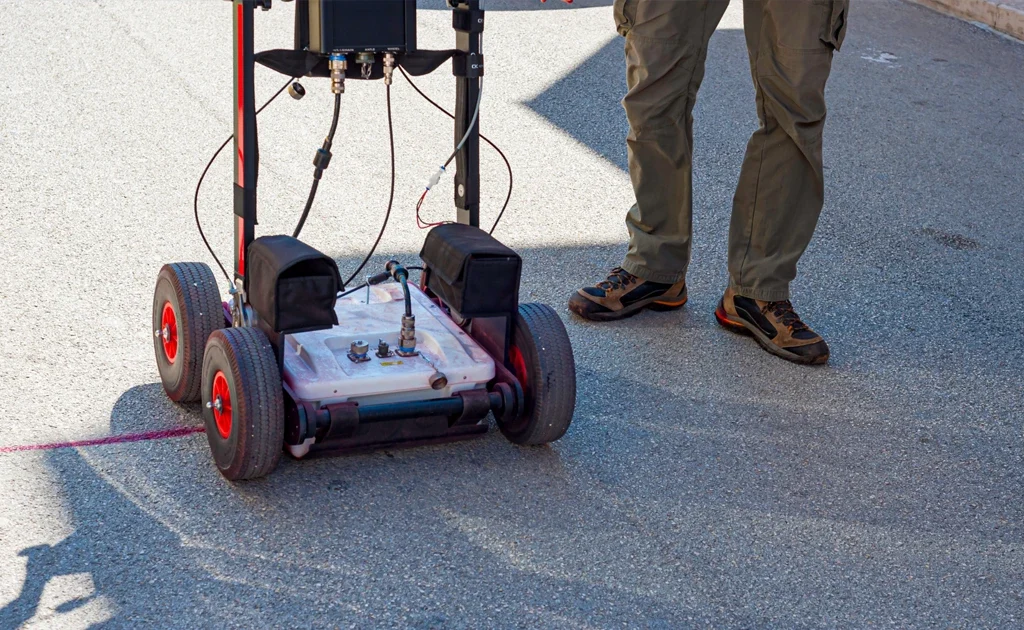
Ground-penetrating radar sends electromagnetic energy into the ground and records reflections caused by changes in subsurface material properties. Because it does not depend on electrical conductivity in the target, GPR may detect both metallic and non-metallic utilities.
Under suitable conditions, GPR can help identify plastic water mains, trench boundaries, disturbed soil, buried structures, and other features associated with utility construction.
Its performance is highly site-dependent. Soil moisture, clay content, salts, target depth, pipe diameter, surface conditions, and interference from other infrastructure can all affect the result.
The Federal Highway Administration notes that moisture and clay can attenuate radar signals and significantly limit utility detection. Smaller pipes may also fail to produce a sufficiently strong response in noisy conditions.
GPR data also requires interpretation. The equipment may identify an anomaly without proving that the anomaly is the specific water main being sought.
Advantages: Non-invasive and capable of detecting non-metallic objects under favourable conditions.
Disadvantages: Performance can decline in wet or clay-rich soils, congested corridors, deeper installations, and sites with limited contrast between the pipe and surrounding material.
4. Use Vacuum Excavation or Potholing
Vacuum excavation provides direct physical confirmation of a pipe’s location, material, depth, and orientation.
Crews can expose the main at selected points and use those points to establish its alignment. Potholing is particularly valuable before high-risk excavation or when indirect locating methods produce conflicting results.
Its principal limitation is that each excavation confirms only one point. Several potholes may be necessary to identify bends, offsets, or unexpected changes in alignment.
It can also require traffic control, permits, restoration, and coordination with excavation contractors.
Advantages: Provides direct and highly reliable confirmation at the exposed location.
Disadvantages: More disruptive and costly than surface locating, and it does not continuously map the pipe between exposure points.
5. Insert a Sonde or Conductive Rod
Where the inside of a pipe or connected conduit is accessible, a sonde, push rod, inspection camera, or conductive cable may be inserted and tracked from the surface.
This method can work well for empty conduits, sewers, drains, and some service lines. Its usefulness for pressurized water mains is more limited because access may require isolation, disassembly, dewatering, disinfection, or specialized insertion equipment.
Advantages: Can provide a strong, traceable signal along an accessible route.
Disadvantages: Requires internal access and may not be practical for an active potable water main.
6. Apply an Acoustic Signal to the Water Main
Acoustic locating provides another approach when the pipe itself is not electrically conductive.
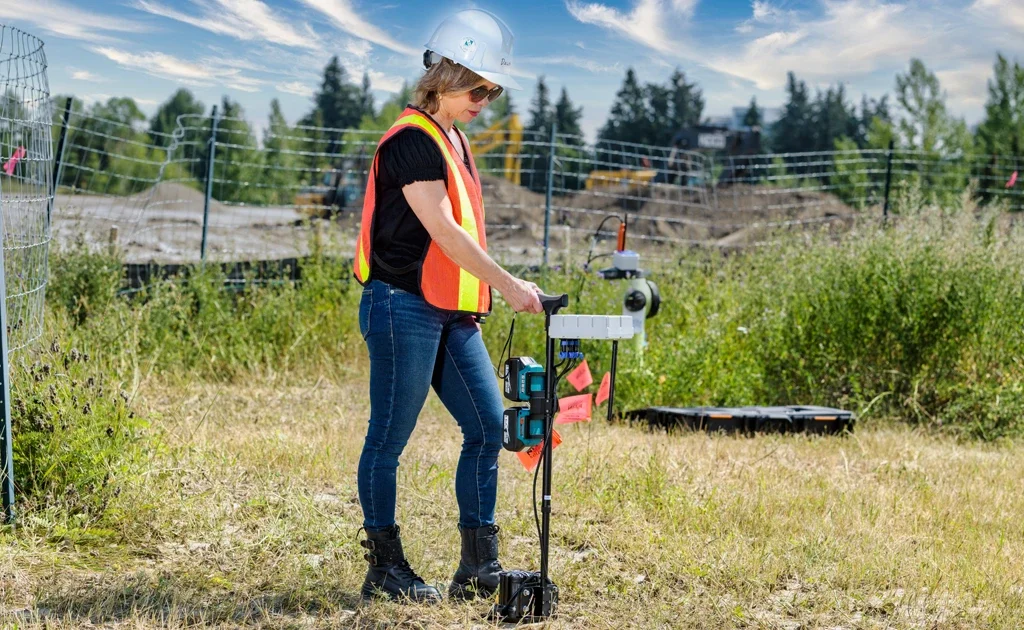
Rather than transmitting an electromagnetic signal along a tracer wire, an acoustic system introduces a controlled vibration into the water system through an accessible connection. A surface receiver then detects the response transmitted through the pipe, water column, and surrounding ground.
This approach can be useful for PVC, HDPE, concrete, asbestos cement, and other pipes that cannot be directly located using conventional electromagnetic equipment.
Acoustic locating does not eliminate the need for records, experienced interpretation, or physical verification. Results can be influenced by pipe depth, diameter, pressure, soil conditions, nearby mechanical noise, pipe connections, and access to the water system.
Its value is that it gives utilities another non-invasive method for tracing a water main when the tracer wire is broken, missing, or inaccessible.
Advantages: Designed for non-metallic water infrastructure and does not depend on an intact tracer wire.
Disadvantages: Requires a suitable access point and trained field interpretation. Site conditions can affect signal transmission and detection.
Need to locate buried PVC, HDPE, or other non-metallic water mains?
Where the SonicFinder 1000 Fits
The SonicFinder 1000 is an acoustic pipe locating system developed specifically for difficult-to-locate water and gas infrastructure.
For water main locating, a controlled acoustic signal is introduced through an accessible system connection. The operator then uses a surface probe and receiver to identify the pipe alignment from above ground.
This gives utilities a way to investigate PVC, HDPE, concrete, and other non-metallic water mains without relying on conductivity from the pipe or tracer wire. It can also provide an additional source of evidence when records are uncertain or when GPR conditions are unfavourable.
The SonicFinder 1000 should not be viewed as a replacement for every existing locating method. It fits within a multi-method utility locating process that may also include:
- Records review
- Electromagnetic locating
- GPR
- Valve and appurtenance investigation
- Acoustic locating
- Vacuum excavation
- Survey and GIS documentation
The most appropriate method depends on the pipe material, site conditions, required confidence level, and consequence of an incorrect locate.
A Multi-Method Approach Produces Better Locates
When crews need to locate a water main without tracer wire, no single method can guarantee success in every situation.
Records may narrow the route but not provide excavation-grade accuracy. Electromagnetic equipment may find fittings but not the pipe between them. GPR may perform well in one soil and poorly in another. Potholing provides direct confirmation but only at individual points. Acoustic locating can trace non-metallic pipe but still requires suitable access and field interpretation.
The strongest approach combines these methods and compares the results.
For utilities dealing with tracer wire failure, broken PVC tracer wire, missing records, or difficult abandoned infrastructure, acoustic locating adds an important option to the locating toolbox. Systems such as the SonicFinder 1000 allow crews to investigate the pipe itself rather than depending entirely on a wire that may have been damaged decades ago.
That additional capability can help utilities reduce uncertainty, plan excavation more confidently, and improve the long-term accuracy of their infrastructure records.