

The Challenge
Large-diameter concrete water mains can be difficult to locate when conventional methods are limited by pipe material, soil conditions, or incomplete records. In this project, the utility had general knowledge of the pipe alignment, but the line became difficult to follow when it turned away from the roadway.
The project involved a large concrete water trunk main, understood to be approximately 42 inches in diameter. Because concrete pipe may not provide reliable electrical continuity, traditional electromagnetic locating methods can struggle, especially where metallic elements are discontinuous or where access to a continuous conductive path is unavailable. Ground penetrating radar was also not a viable option in the site’s soil conditions.
The utility needed a practical way to confirm the pipe alignment from the surface and continue tracking the main through a difficult section.
The Solinas Solution
The SonicFinder 1000 approached the problem differently. Instead of relying on electrical conductivity, the system used acoustic vibration. The actuator introduced sound energy into the ground, and the sensor measured the acoustic response through the pipe and surrounding soil.
This distinction is important. For the SonicFinder 1000, the pipe does not need to be electrically continuous. It needs to provide an acoustic path that allows the system to detect the strongest response when the locator passes over the buried main.
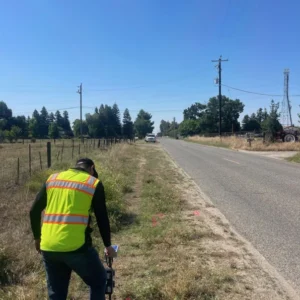
On this project, the team was able to spot the concrete trunk main successfully. The locate progressed approximately 175 to 200 feet before the crew needed to establish another contact point by probing down to the crown of the pipe. Once the sensor was moved to the new contact point, the locate could continue.
The Result
The SonicFinder 1000 successfully located the large-diameter concrete water main in conditions where GPR was not practical and traditional locating methods faced limitations.
The project demonstrated several important advantages:
Effective locating on large-diameter concrete pipe
Performance where electrical continuity could not be assumed
Ability to continue the locate by creating a new acoustic contact point
Reduced dependence on broad exploratory excavation
A practical field workflow for difficult trunk main alignments
For utilities managing older concrete, PCCP, C305, C900, or bar-wrapped pipe infrastructure, this project shows how acoustic locating can provide another option when conventional methods do not provide enough confidence.
About Solinas Technologies:
At Solinas Technologies our mission is to develop locating technologies, where no locating has been possible, with a focus on public safety. We have two primary technologies: Accurate location of plastic pipe without tracer wire installed on it has long been an issue for both gas and water utilities. While acoustical methods have been used in the past to find plastic pipe, they have had only limited effectiveness. We have developed a new innovative patented technology for plastic pipe location using acoustics that is both fast and effective. An acoustic technology to rapidly locate and document the location of Lead Service Lines (LSL’s) to help water utilities prioritize them for replacement. The technology works by placing an acoustic executor and transducer on a service key. There is no need to enter the house or building, making the technology very efficient and fast to implement.