Brad Horton, VP of Sales at Solinas Technologies, has dedicated his career to finding what you can’t see – a common challenge for utilities locating buried assets.
 Horton’s journey into the locating industry began in 1989, when he started working for contract locators, spending his days tracking down buried pipes and cables for municipal and utility clients. Horton recalls, “It was hands-on work that gave me an intimate understanding of the frustrations that would later drive serious technological innovation.”
By the mid-1990s, Horton had transitioned to the manufacturing side, selling locators and gaining insight into the technology’s limitations. This dual perspective—as both user and vendor—would prove invaluable when he co-founded Solinas Technologies and co-invented the SonicFinder 1000.
The Problem That Wouldn’t Go Away
For decades, the utility industry has wrestled with a stubborn problem: how to locate non-metallic pipes buried underground. Traditional electromagnetic locating works well for metal pipes, but plastic, PVC, concrete, and other non-metallic materials are essentially invisible to conventional equipment.
“The difficulty with locating non-metallic, non-traceable pipes using electromagnetic locating,” Horton explains, “is that your fallback is ground penetrating radar, and ground penetrating radar has limitations to the soil types that it works in.”
When ground penetrating radar (GPR) fails, which it often does in certain soil conditions, contractors have been known to use dowsing or “witching” with bent wire coat hangers. “Most gas companies do not allow you to use this methodology because it’s so wonky and archaic,” Horton notes, though he admits the practice is surprisingly common on job sites.
The consequences of this technological gap are serious. Without reliable locating methods, contractors often resort to exploratory digging, turning a precision operation into expensive guesswork. “If you’re going to roll out a 2½-ton dump truck with a lowboy trailer and a backhoe and four guys, you’ve got $10,000 digging that hole at a minimum,” Horton points out.
The financial costs pale in comparison to the safety risks. Horton describes the worst-case scenario with the gravity of someone who’s seen it happen: “You could strike a gas line, pull the line out of the bottom of the meter set, get gas in the house and end up with an explosion. That’s what everybody wants to avoid.”
Even water lines pose significant challenges. Damage means expensive repairs, project delays, and in the worst cases, flooded roads or compromised infrastructure. The liability issues have led most major utilities to outsource locating work to contractors, shifting the risk and responsibility to third parties.
 The Game Changer
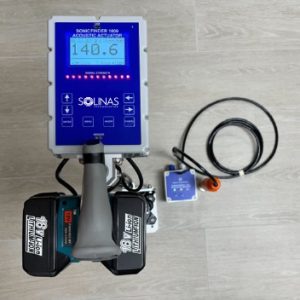
After two years of research and development, Horton and his partner, Aris Bates at Solinas Technologies, created the SonicFinder 1000, a device that uses acoustic technology to locate non-metallic pipes without the limitations of traditional methods.
The technology’s success rate is impressive. “We’re probably 85 to 90% accurate when we go out to find these pipes,” Horton reports. Some users are seeing even better results. A contractor in Perth, Australia, achieved a 100% success rate locating gas service lines over his first month and a half with the device. Similarly, an operator in southern Ohio working with water lines reports perfect success in his favorable soil conditions.
What sets the SonicFinder apart isn’t just its effectiveness, but its simplicity. “It’s easy to learn how to use,” Horton says. He’s trained experienced locators in as little as one hour via video call, while field training typically takes two to three hours. Even complete novices can be trained in a single day.
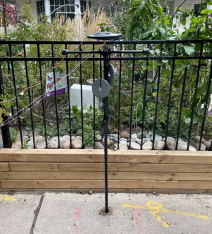
Here’s how it work. The field personnel access a gas or water meter outside of house and quick connects the receiver (listening device) onto the service. They then move toward the buried asset with the portable transmitter which creates an acoustic condition. The transmitter will indicate when they have located the service of interest via communication back to the receiver. The person marks out the buried pipe asset in a series of passes, and then quickly and easily de-mobilizes and moves to the next site.
SonicFinder Saves the Day
Perhaps no story illustrates the technology’s impact better than an emergency call Horton received during a demonstration. A local gas company had a broken tracer wire on a 120-foot gas service crossing under a busy road. When Horton arrived, he found a small army of workers: four gas company employees, traffic control contractors, and heavy equipment including a dump truck, trailer, and backhoe.
The crew had already dug a massive hole—five feet deep, eight feet wide, and six feet long—and were digging in the wrong direction. “I hooked up the SonicFinder 1000, located it across the road about a foot and a half to the west of their existing hole,” Horton recalls. “They repositioned the backhoe, started digging to the west where I’d indicated, and in about 15-20 minutes, they found the wire.”
Horton estimates the original excavation cost around $12,000-$15,000, factoring in equipment, personnel, and traffic control. Had they used the SonicFinder first, the job could have been completed with two workers and shovels, eliminating the need for heavy equipment and traffic disruption entirely.
 The impact was immediate: that same gas company convinced their contract locator to purchase three SonicFinder units.
The Bigger Picture
For Horton, the technology represents more than just a better tool—it’s a fundamental shift in how the industry approaches underground utility work. “We’ve had two longtime locator sales organization leaders, people with 30-plus years experience, say this is potentially industry changing,” said Horton.
The device fills a critical gap in the industry’s toolkit. “It’s not a silver bullet,” Horton acknowledges, “but an excellent next arrow in the quiver if electromagnetic locating doesn’t work, if GPR does not work in the geographic area you’re in.”
As VP of Sales, Horton spends much of his time training resellers and working directly with customers to demonstrate the technology. “Every customer who’s purchased the device reports satisfaction, and many describe it as transformational for their operations,” says Horton.
The technology works on everything from gas services to 36-inch concrete pipes, and success stories are accumulating. For an industry that has struggled with the same fundamental problem for decades, the SonicFinder 1000 represents a genuine breakthrough.
As Horton puts it, “There’s not a single person that has buyer’s remorse or regret. It is absolutely a game changer.” For contractors tired of playing underground guessing games, that might be the most important testimonial of all.
About Solinas Technologies:
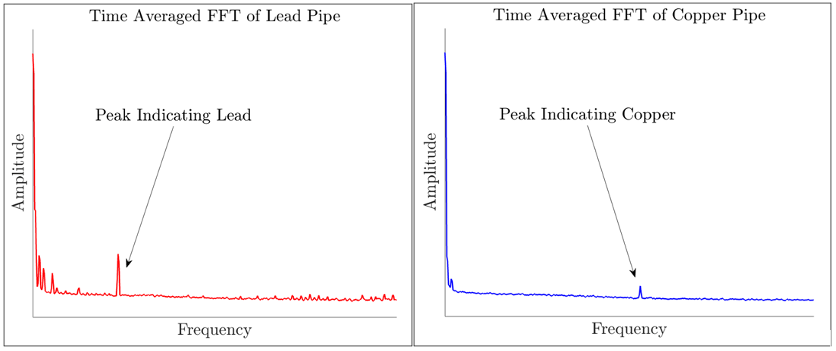
At Solinas Technologies our mission is to develop locating technologies, where no locating has been possible, with a focus on public safety. We have two primary technologies: Accurate location of plastic pipe without tracer wire installed on it has long been an issue for both gas and water utilities. While acoustical methods have been used in the past to find plastic pipe, they have had only limited effectiveness. We have developed a new innovative patented technology for plastic pipe location using acoustics that is both fast and effective. An acoustic technology to rapidly locate and document the location of Lead Service Lines (LSL’s) to help water utilities prioritize them for replacement. The technology works by placing an acoustic executor and transducer on a service key. There is no need to enter the house or building, making the technology very efficient and fast to implement.